sat suite question viewer
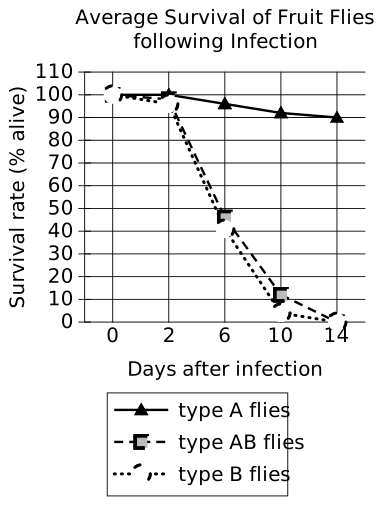
- The following 3 lines are shown:
- type A flies
- type AB flies
- type B flies
- The type A flies line:
- Begins at 0 days, 100%
- Remains level to 2 days after infection, 100%
- Falls gradually to 6 days after infection, 96%
- Falls gradually to 10 days after infection, 92%
- Falls gradually to 14 days after infection, 90%
- The type AB flies line:
- Begins at 0 days after infection, 100%
- Falls gradually to 2 days after infection, 98%
- Falls sharply to 6 days after infection, 46%
- Falls sharply to 10 days after infection, 12%
- Falls sharply to 14 days after infection, 0%
- The type B flies line:
- Begins at 0 days after infection, 100%
- Falls gradually to 2 days after infection, 96%
- Falls sharply to 6 days after infection, 41%
- Falls sharply to 10 days after infection, 4%
- Falls gradually to 14 days after infection, 0%
In a study of the evolution of DptA and DptB—Diptericin genes encoding antimicrobial peptides that combat pathogens and foster beneficial microbes in fruit flies (Drosophila)—researchers assessed Drosophila melanogaster resistance to pathogenic infections by Providencia rettgeri and Acetobacter sicerae, bacteria common in the flies’ environments. Subjects included flies identified by mutations silencing DptA, DptB, or both DptA and DptB (termed types A, B, and AB, respectively). In conjunction with the observation that resistance to P. rettgeri correlates with DptA activity but is not significantly affected by DptB activity, data in the graph of survival rates post–A. sicerae infection suggest that blank
Which completion of the text is best supported by data in the graph?
Explanation
Choice C is the best answer because it most logically completes the text based on supporting data in the graph. The text indicates that in the fly D. melanogaster, DptA and DptB are genes that encode peptides that both fight pathogens and promote beneficial microbes. Researchers tested D. melanogaster’s resistance to P. rettgeri and A. sicerae bacteria based on which variation of the peptide-encoding gene the flies exhibit: DptA silenced (referred to as type A), DptB silenced (type B), or both silenced (type AB). The text also indicates that resistance to P. rettgeri correlates with DptA activity but not with DptB activity (which would manifest as type B flies surviving at a higher rate than other fly types when exposed to P. rettgeri). The graph shows the post–A. sicerae infection results, which indicate that DptB activity was most strongly associated with survival, whereas DptA activity was not (manifesting in the graph as the type A flies having greater survival rates than the other fly types). In other words, when DptA activity was silenced, the flies showed relatively high survival rates, but when DptB activity was silenced, whether on its own or in conjunction with DptA activity being silenced, survival rates were low, suggesting that DptB may have developed as a specific defense against A. sicerae.
Choice A is incorrect. The graph suggests that DptA activity is associated with a low rate of survival, not a high one. Furthermore, the graph shows results for flies where DptA alone was silenced, DptB alone was silenced, and both were silenced and thus does not show any flies with activity in both DptA and DptB, which would be necessary to determine whether DptA conferred defense against A. sicerae in the presence of DptB. Choice B is incorrect. Only two bacteria species were considered in the text: P. rettgeri and A. sicerae. The text and graph taken together suggest that activity in DptA is associated with resistance to P. rettgeri while DptB activity is not, and that DptB activity is associated with resistance to A. sicerae while DptA is not. There is no further information to suggest one genetic type confers resistance to a greater number of pathogens than the other. Choice D is incorrect. The graph does not address flies with activity in both DptA and DptB. All flies represented in the graph had one or both of DptA and DptB silenced, or inactive.